
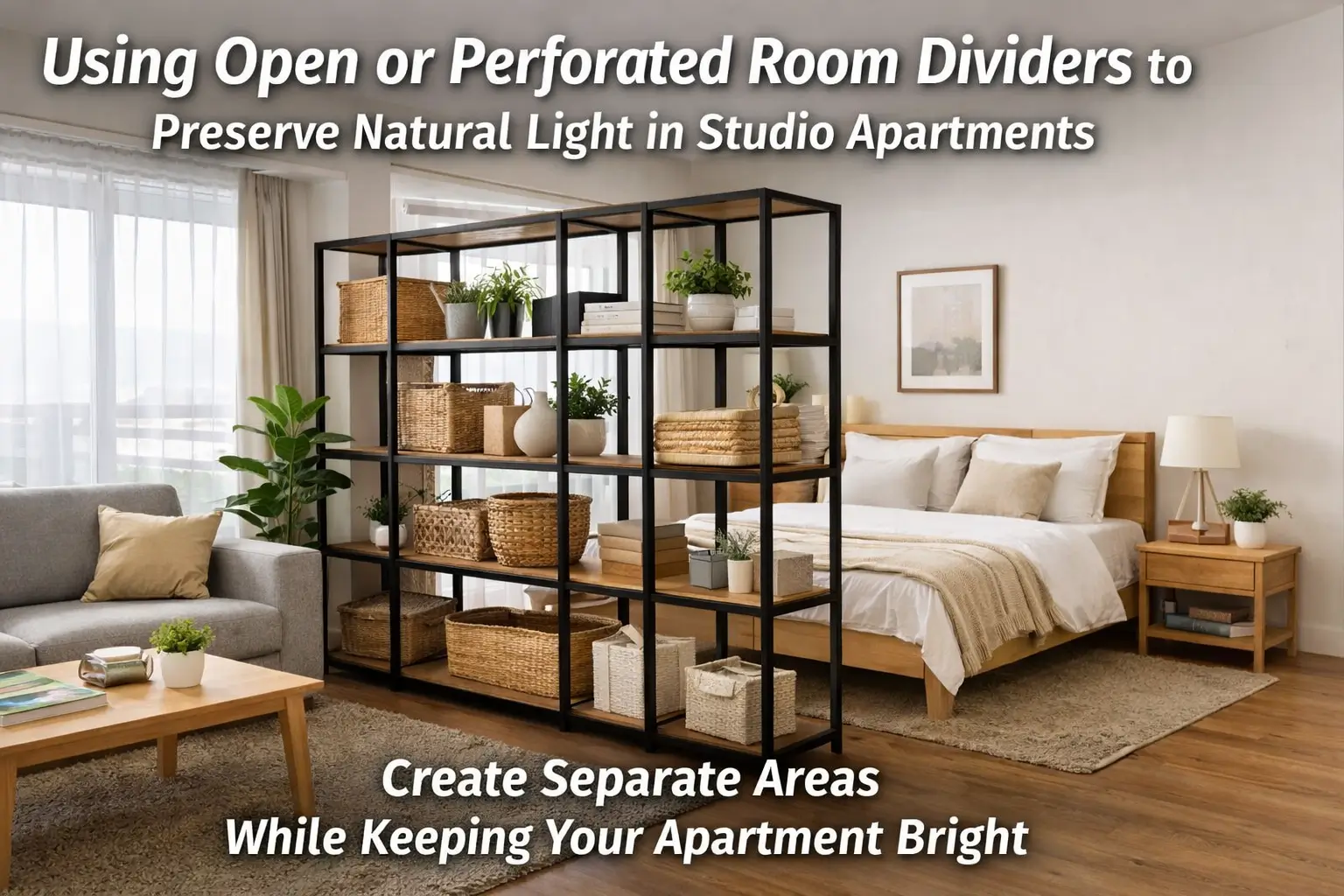
Living in a studio apartment offers simplicity, efficiency, and affordability, but it also presents a unique design challenge: how to separate functional areas without making the space feel smaller or darker. Because studio apartments typically rely on one or two main windows, preserving natural light is essential to maintain comfort, visual openness, and overall livability.
Many renters hesitate to use room dividers because traditional solid partitions can block sunlight, making the apartment feel enclosed and restrictive. This is especially problematic in rental units where structural changes are not allowed. Fortunately, open or perforated room dividers provide an effective solution by allowing light to flow freely while still creating distinct zones for sleeping, working, and relaxing.
This guide will show you exactly how to choose, position, and install open or perforated room dividers step by step. You will learn how to preserve natural light, improve functionality, and create a well-organized studio apartment without making permanent changes to your rental.
Why Natural Light Is Critical in Studio Apartments
Natural light is one of the most valuable features in any small living space. In studio apartments, it plays an even greater role because it directly affects how large, comfortable, and welcoming the space feels.
When natural light flows freely throughout your apartment, it creates several important benefits:
- Makes the space appear larger and more open
- Improves mood and emotional well-being
- Enhances focus and productivity, especially for remote workers
- Reduces the need for artificial lighting during the day
- Improves the visual clarity and aesthetics of your interior
When natural light is blocked by solid partitions, the opposite happens. The apartment feels smaller, darker, and more confined. This is why open or perforated dividers are essential. They allow separation without sacrificing brightness.
Think of natural light as a resource. The goal is not just to have light near the window, but to allow that light to travel throughout the entire apartment.
What Are Open or Perforated Room Dividers
Open or perforated room dividers are partitions designed with gaps, openings, or translucent surfaces that allow light to pass through. Unlike solid walls or opaque screens, these dividers preserve brightness while still creating visual separation.
There are several common types, each with its own advantages:
Slatted Dividers
Slatted dividers consist of vertical or horizontal slats with space between them. These gaps allow light to travel while still creating a visual boundary.
Advantages include:
- Excellent light preservation
- Modern and minimalist appearance
- Good balance between openness and separation
- Ideal for separating sleeping and living areas
Mesh or Grid Dividers
Mesh dividers use metal or wire grids. These are extremely effective at preserving light while creating subtle separation.
Benefits include:
- Maximum light flow
- Industrial or modern aesthetic
- Lightweight and easy to install
- Affordable and renter-friendly
Open Shelving Units
Open shelving units are one of the most practical divider options. They separate spaces while providing storage.
Benefits include:
- Dual functionality (storage and separation)
- Light passes through open sections
- No permanent installation required
- Ideal for renters
Translucent Panels
Translucent panels allow light to pass through while softening visibility.
Advantages include:
- Preserves brightness
- Provides more privacy than open slats
- Modern and clean appearance
Why Open Dividers Are Ideal for Rental Apartments
Renters must be careful not to damage walls, floors, or ceilings. Permanent walls or heavy installations are usually not allowed. Open dividers solve this problem.
They offer several rental-friendly advantages:
- No permanent construction required
- Easy installation without drilling
- Portable and movable
- Flexible layout adjustments
- Easy removal when moving out
This makes them perfect for temporary living situations.
Freestanding dividers are especially useful because they do not require attachment to walls.
Step-by-Step: Identify Your Light Sources First
Before choosing a divider, you must understand how light enters your apartment.
Step 1: Locate all natural light sources
Walk through your apartment and identify:
- Windows
- Balcony doors
- Glass sliding doors
These are your primary light entry points.
Step 2: Observe how light travels
Pay attention to:
- Which areas receive the most light
- Which areas remain darker
- How light moves during the day
This helps you understand where dividers should and should not be placed.
Step 3: Identify areas that must remain open
Certain areas should never be blocked, including:
- Direct paths between windows and the center of the room
- Primary living areas
- Workspace areas
Protect these light pathways.
Step-by-Step: Define Functional Zones in Your Studio
The purpose of a divider is to separate functions, not block light.
Most studio apartments include several functional zones:
- Sleeping area
- Living area
- Workspace
- Dining area
Start by deciding which zones need separation.
For example:
- Separate your bed from your living room for privacy
- Separate your workspace for better focus
Avoid over-dividing the space.
Too many partitions reduce openness.
Step-by-Step: Choose the Best Divider Material
The material of your divider determines how much light passes through.
Best materials for light preservation:
- Wooden slats
- Metal mesh
- Open shelving
- Perforated panels
- Translucent acrylic
Materials to avoid:
- Solid wood panels
- Opaque plastic panels
- Thick, solid screens
Always prioritize light-permeable materials.
The more open the structure, the better the light flow.
Step-by-Step: Choose the Correct Divider Height
Height plays a major role in balancing light and privacy.
Full-height dividers
Advantages:
- Maximum separation
- Better privacy
Disadvantages:
- May block some light
Half-height dividers
Advantages:
- Maximum light flow
- Maintains openness
Disadvantages:
- Less privacy
Medium-height dividers (recommended)
Advantages:
- Good balance between privacy and light
- Ideal for most studio apartments
Medium-height dividers are usually the best choice.
Step-by-Step: Position the Divider Correctly
Proper positioning is the most important factor.
Best placement strategy:
Place the divider perpendicular to the window.
This allows light to travel around the divider.
Avoid this common mistake:
Do not place dividers directly between the window and the center of the room.
This blocks the main light path.
Ideal placement examples:
- Between bed and living area
- Between workspace and sleeping area
- Near the center, but offset from the window
Always leave open pathways for light.
Best Types of Open Dividers for Studio Apartments
Some divider types work especially well in studio apartments.
Open bookshelf divider
Advantages:
- Storage and separation combined
- Excellent light preservation
- No installation required
Vertical slat divider
Advantages:
- Modern appearance
- Excellent light flow
- Strong visual separation
Folding screen with perforations
Advantages:
- Portable
- Flexible
- Easy to reposition
Curtain with sheer fabric
Advantages:
- Very affordable
- Easy installation
- Excellent light preservation
Installation Methods Safe for Renters
Choose installation methods that do not damage the apartment.
Best renter-friendly options:
- Freestanding dividers
- Tension-mounted systems
- Modular panels
- Folding screens
These require no drilling.
Avoid permanent installation methods.
Common Mistakes That Block Natural Light
Avoid these mistakes:
Mistake 1: Using solid dividers
Solid materials block light completely.
Mistake 2: Blocking the window path
Never place dividers directly in front of windows.
Mistake 3: Using overly tall dividers
Tall dividers reduce light spread.
Mistake 4: Overcrowding the apartment
Too many dividers reduce openness.
Keep the layout simple.
Additional Tips to Maximize Natural Light
You can improve light flow even further with these techniques:
Use mirrors strategically
Mirrors reflect light deeper into the room.
Place mirrors opposite windows.
Use light colors
Light colors reflect light better.
Choose:
- White
- Beige
- Light gray
Keep windows clear
Avoid heavy curtains.
Use sheer curtains instead.
Budget-Friendly Divider Ideas
You do not need to spend a lot of money.
Affordable options include:
- Open shelving units
- Folding screens
- Curtain dividers
- DIY slat dividers
These options are effective and affordable.
Conclusion
Open or perforated room dividers are one of the best solutions for separating functional areas in a studio apartment without sacrificing natural light. They allow you to create privacy, improve organization, and enhance the visual structure of your space while preserving brightness and openness.
By carefully choosing light-permeable materials, selecting the correct height, and positioning the divider strategically, you can maintain strong natural light flow throughout your apartment. This ensures your studio remains comfortable, visually spacious, and functional.
For renters, these dividers offer the perfect balance between flexibility and practicality. They require no permanent installation, cause no structural damage, and can easily be moved or removed when needed. With the right approach, you can transform your studio apartment into a well-organized and light-filled living environment.
Frequently Asked Questions
1. Do open room dividers really preserve natural light?
Yes. Their open structure allows light to pass through gaps, preserving brightness throughout the apartment.
2. What is the best divider type for studio apartments?
Open shelving, slatted dividers, and mesh dividers are among the best options.
3. Are open dividers suitable for renters?
Yes. Most open dividers are freestanding and do not require permanent installation.
4. Where should I place the divider for best light flow?
Place it perpendicular to windows and avoid blocking direct light pathways.
5. Are affordable divider options effective?
Yes. Even budget options like curtains and shelving units can preserve natural light effectively.