
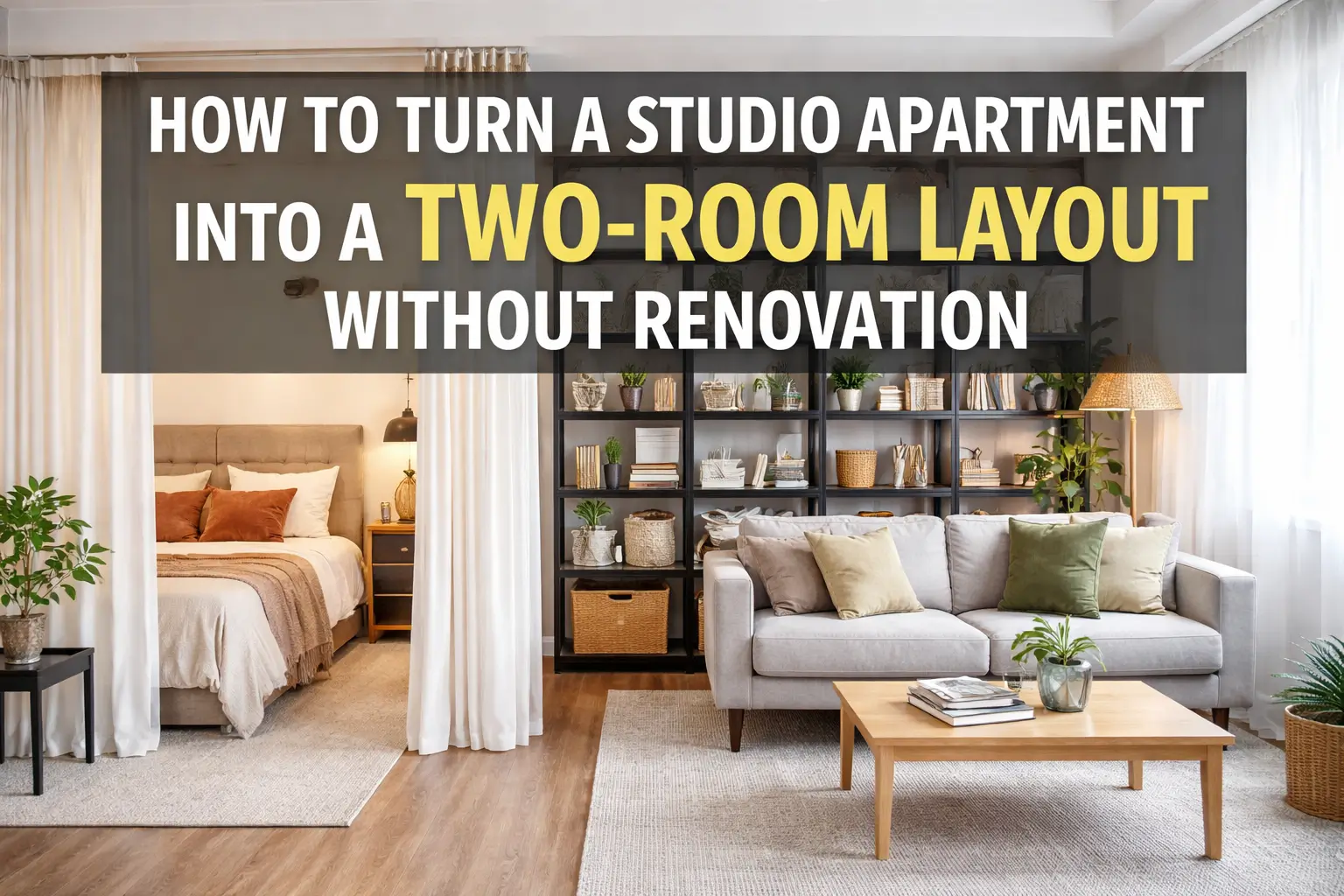
Living in a studio apartment offers undeniable advantages: lower rent, easier cleaning, and often a prime city location. However, the biggest drawback is equally clear — everything happens in a single open space. Your bedroom blends into your living room, your workspace competes with your dining area, and privacy feels almost nonexistent.
For renters, the situation becomes more complicated. Lease agreements typically prohibit structural changes. You cannot build walls, relocate doors, or install permanent partitions. Even if permission were granted, the cost and effort would rarely justify the investment in a temporary home.
The good news is this: you don’t need renovation to create separation. With strategic layout planning, visual dividers, lighting control, and smart furniture placement, you can transform a studio into a functional two-room layout — completely reversible and landlord-friendly.
Below is a professional, detailed step-by-step system to help you do exactly that.
Analyze Your Space Before Moving Anything
Before buying dividers or rearranging furniture, take time to evaluate your layout objectively.
Start by asking:
- Where are the windows located?
- Where does natural light enter most strongly?
- Where are outlets positioned?
- Where is the entrance door?
- What is the current traffic flow?
Understanding these elements prevents costly mistakes.
For example, placing a tall divider directly in front of your only window will darken both zones. Positioning your bed near the entry may reduce the sense of privacy. Good design begins with observation, not impulse purchases.
Draw a simple floor plan on paper. Measure wall lengths and mark window positions. Even a basic sketch will clarify possibilities.
Define the Two Primary Zones
The goal is not to create five mini-rooms. In most studio layouts, dividing the space into two strong zones works best:
- A private zone (bedroom area)
- A social or functional zone (living room, office, or combined area)
Decide which function deserves priority.
If you work from home, your productive zone may require stronger separation. If sleep quality is your focus, prioritize privacy for the bedroom zone.
Keep these principles in mind:
- The bedroom should feel sheltered.
- The living area should feel open.
- Both zones should maintain light access.
Clarity at this stage ensures cohesion later.
Position the Bed Strategically
Professional designers always start with the bed in studio layouts. It is the largest visual element and sets the structure for the rest of the space.
Ideal bed placement:
- Farthest from the entrance door.
- Against a solid wall when possible.
- Positioned so it does not block windows.
If possible, avoid placing the bed in the center of the apartment. Floating beds without structure often make studios feel chaotic.
To reinforce the bedroom identity:
- Use a large area rug under the bed.
- Add symmetrical bedside tables or lamps.
- Choose consistent bedding colors.
These elements signal “this is a bedroom” even without walls.
Use Visual Dividers Instead of Structural Walls
Walls block light and violate leases. Visual dividers shape perception without permanence.
Effective renter-friendly divider options include:
- Open shelving units (double-sided access).
- Tall bookcases.
- Folding screens.
- Ceiling-mounted curtain tracks (removable systems).
- Tension rod curtain systems.
- Slatted wood panels (non-attached).
Open shelving is often the most practical choice because it provides:
- Physical separation.
- Storage capacity.
- Light permeability.
- Airflow.
When choosing a divider, prioritize height. Ideally, it should reach at least 60–72 inches. Short dividers fail to create psychological separation.
Position the divider perpendicular to a wall to create a defined boundary rather than placing it randomly in the middle of the room.
Use Furniture to Build Invisible Walls
Furniture placement can act as architectural structure.
For example:
- Place the sofa with its back facing the bedroom area.
- Add a console table behind the sofa to strengthen the boundary.
- Position a desk perpendicular to a wall to define a work corner.
- Use a storage bench at the foot of the bed.
Each furniture piece should contribute to defining space.
Avoid pushing all furniture against walls. Floating certain items strategically creates more intentional zones.
Maintain clear walking paths of at least 24–30 inches to preserve flow.
Anchor Each Zone with a Rug
Rugs are one of the most powerful zoning tools in small spaces.
For the bedroom zone:
- Choose a rug large enough to extend beyond the sides of the bed.
- Ensure at least the front two legs of nightstands sit on it.
For the living zone:
- Use a rug that fits under the front legs of the sofa.
- Avoid small rugs that look like isolated islands.
A properly sized rug visually defines a “room” without any structural changes.
Use Lighting to Separate Functions
Lighting is often overlooked, yet it dramatically influences perception.
Use layered lighting:
Bedroom zone:
- Warm light bulbs (2700K–3000K).
- Bedside lamps.
- Soft ambient glow.
Living or work zone:
- Brighter lighting.
- Floor lamps.
- Directional task lighting.
Different light temperatures signal different purposes. Even in one open room, lighting alone can create separation.
Avoid relying solely on overhead lighting. It flattens the entire space and removes intimacy.
Leverage Vertical Space
Most renters focus only on floor layout, ignoring vertical potential.
Maximize height by:
- Using tall shelving units.
- Installing floor-to-ceiling curtains.
- Mounting lightweight wall art.
- Adding vertical storage towers.
Vertical lines draw the eye upward, making the apartment feel larger and more structured.
If ceiling height allows, full-length curtains can act as temporary walls when drawn closed.
Incorporate Multi-Functional Furniture
In small apartments, every item must justify its footprint.
Consider:
- Storage ottomans.
- Lift-top coffee tables.
- Beds with built-in drawers.
- Foldable desks.
- Modular seating.
Hidden storage reduces visual clutter, which is essential when dividing a studio.
Clutter weakens separation. Organization strengthens it.
Control Color and Texture
You do not need to repaint walls to differentiate zones.
Instead:
- Use distinct bedding colors for the bedroom.
- Choose a different throw pillow palette for the living area.
- Add textured curtains behind the bed.
- Group artwork intentionally per zone.
Subtle contrast creates psychological boundaries.
Avoid excessive color variation. Two complementary palettes work best.
Maintain Flow and Avoid Common Mistakes
Common errors include:
- Blocking natural light.
- Choosing dividers that are too short.
- Overcrowding the space.
- Ignoring furniture scale.
- Using mismatched lighting tones.
Before finalizing your layout, walk through the space physically. Test movement paths. Sit on the sofa. Lie on the bed. Observe sightlines.
A successful two-room layout should feel intentional, not cramped.
Budget Planning for Renters
You do not need a large budget to achieve transformation.
Low budget approach:
- Tension rod curtains.
- Area rugs.
- Rearranged furniture.
Mid-range approach:
- Tall shelving unit.
- Storage bench.
- Layered lighting.
Higher investment approach:
- Modular divider systems.
- Designer shelving.
- High-quality textiles.
The key is strategic spending, not excessive spending.
Final Thoughts
Turning a studio apartment into a two-room layout without renovation is not about construction. It is about perception, placement, and planning. By defining zones, positioning the bed strategically, using vertical dividers, anchoring areas with rugs, and layering lighting, you create the psychological structure of two separate rooms.
Renters often assume they are limited by their lease. In reality, constraints can lead to smarter design decisions. When every piece of furniture serves a purpose and every visual boundary is intentional, a studio becomes more than a single open space — it becomes a thoughtfully organized home.
The transformation does not require walls. It requires strategy.
Frequently Asked Questions
1. Can I legally add a temporary wall in a rental apartment?
In most cases, permanent walls require landlord approval. Temporary dividers are safer and reversible.
2. What is the best divider for a small studio?
Open shelving units are the most versatile because they divide space while providing storage.
3. How do I separate my bed from my living room without blocking light?
Use sheer curtains, open bookcases, or tall furniture with open backs.
4. What size rug works best for zoning a studio?
Large rugs that extend beyond furniture edges create stronger visual separation.
5. Does a two-room layout make a studio feel smaller?
No. When done correctly, zoning improves organization and actually makes the space feel larger and more intentional.