
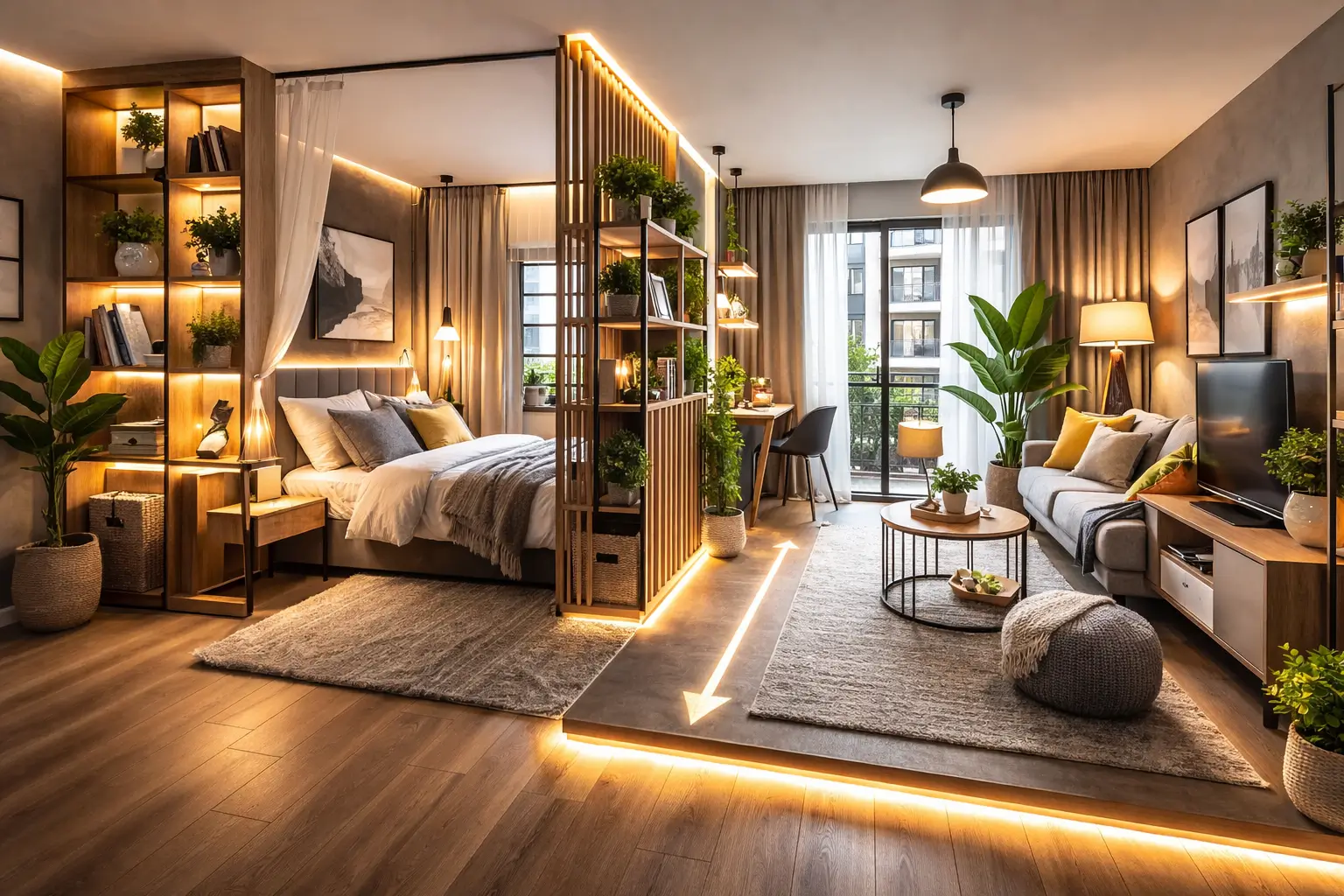
Living in a studio apartment has clear advantages: lower rent, easier maintenance, and a simplified lifestyle. However, when your bed, sofa, workspace, and dining table share the same open area, the lack of separation can quickly affect comfort and functionality.
When there are no clear zones, your brain struggles to distinguish between rest and activity. This can impact sleep quality, productivity, and even how organized your home feels. Separating your bedroom and living room without building permanent walls allows you to:
- Increase privacy
- Improve sleep hygiene
- Make the space feel larger
- Reduce visual clutter
- Create a more intentional layout
The good news is that you don’t need construction, permits, or expensive renovations. With smart layout strategies and practical solutions, you can transform your studio into a structured, comfortable home.
Step 1: Use Furniture as Functional Room Dividers
Furniture is the most practical and renter-friendly way to create separation. Instead of pushing everything against the walls, use key pieces to form natural boundaries.
1.1 Position a Bookcase Perpendicular to the Wall
An open-back bookcase is one of the most effective dividers.
Why it works:
- Creates visual separation
- Allows natural light to pass through
- Adds valuable storage
- Maintains airflow
How to do it step by step:
- Measure the space between your bed and living area.
- Choose a tall but not bulky shelf.
- Position it perpendicular to the wall.
- Anchor it securely for safety.
- Style both sides intentionally (books on one side, décor or storage baskets on the other).
This method works especially well in small apartments because it divides the space without closing it off completely.
1.2 Use the Back of the Sofa as a Boundary
Your sofa can define the living area instantly.
Step-by-step layout approach:
- Place the bed against a wall or in a corner.
- Position the sofa with its back facing the bed.
- Add a narrow console table behind the sofa.
- Place a rug under the living area to reinforce the zone.
This technique creates a psychological boundary. Even without a physical wall, the layout signals that two different areas exist.
1.3 Use a Wardrobe as a Divider
If you lack closet space, this is a smart double-function solution.
- Place a wardrobe between the sleeping and living zones.
- Choose a model with doors facing the bedroom side.
- Keep the living side clean and styled with art or mirrors.
This solution provides privacy and storage at the same time.
Step 2: Install Curtains for Flexible Separation
Curtains are one of the simplest and most affordable options.
They allow you to create privacy when needed and open the space during the day.
Why Curtains Are Effective
- Budget-friendly
- Easy to install
- No permanent damage
- Customizable fabric options
- Softens the room visually
Step-by-Step Installation Guide
- Measure the width of the area you want to divide.
- Install a ceiling-mounted curtain track for a modern look.
- Choose fabric depending on your needs:
- Sheer for light filtering
- Blackout for privacy
- Hang curtains slightly higher than the ceiling line to create height illusion.
- Ensure curtains touch the floor for a clean finish.
For studio apartments, ceiling tracks work better than tension rods because they look intentional rather than temporary.
Step 3: Use Folding Screens for Instant Separation
If you want a non-permanent solution, folding screens are ideal.
Advantages
- No installation required
- Portable
- Easy to store
- Available in many styles
Best Types for Small Spaces
- Wooden slatted screens (allow airflow)
- Fabric panel dividers
- Minimalist metal frames
To use effectively:
- Place the screen slightly offset from the bed rather than directly at the foot.
- Leave a small walking path to maintain flow.
- Avoid oversized or heavy models.
Screens are especially useful if you frequently rearrange furniture.
Step 4: Define Zones Using Rugs
Not all separation has to be vertical. Floor definition can be just as powerful.
How Rugs Create Visual Boundaries
When you place different rugs under different functional areas, your eyes automatically identify distinct zones.
Practical Setup
- Use one large rug for the living area.
- Use a separate rug under the bed.
- Ensure the rugs vary slightly in texture or tone.
Avoid very small rugs that look disconnected. The living room rug should be large enough to anchor the sofa and coffee table.
Step 5: Install Sliding Panels or Temporary Partitions
If you want something more structured than curtains but still renter-friendly, sliding panels are a strong option.
Types of Temporary Panels
- Track-mounted fabric panels
- Frosted acrylic partitions
- Lightweight wooden frames
Installation Steps
- Measure ceiling height accurately.
- Choose a track system that doesn’t require structural modifications.
- Install panels slightly wider than the bed area.
- Test sliding movement before final positioning.
Frosted panels allow light while offering privacy, which prevents the room from feeling closed off.
Step 6: Use Smart Storage to Divide and Organize
Clutter makes small spaces feel even smaller. Dividing your space while adding storage solves two problems at once.
Smart Divider Ideas
- Cube storage units
- Storage benches
- Low cabinets
- Dual-sided shelving
When choosing storage dividers, consider:
- Height relative to ceiling
- Weight and stability
- Accessibility from both sides
The goal is to improve organization while maintaining visual lightness.
Step 7: Separate Areas with Strategic Lighting
Lighting changes how we perceive space.
Instead of using one overhead light, create layered lighting zones.
Bedroom Lighting
- Warm bulbs (2700K–3000K)
- Soft bedside lamps
- Wall sconces if possible
Living Room Lighting
- Floor lamp near sofa
- Table lamp on console
- Neutral white lighting for activity
By adjusting brightness and color temperature, you reinforce the functional separation without adding physical barriers.
Step 8: Use Vertical Space with Loft Beds or Platforms
If your ceiling height allows it, vertical separation is extremely effective.
Loft Beds
They elevate the sleeping area, freeing the space underneath for:
- A sofa
- A workspace
- Storage
Raised Platforms
A platform bed subtly elevates the sleeping zone and creates distinction.
When using vertical separation:
- Check ceiling height carefully.
- Ensure safety rails are installed.
- Maintain adequate ventilation.
This method works particularly well in compact studios under 500 square feet.
Common Mistakes to Avoid
Even smart solutions can fail if poorly executed.
1. Blocking Natural Light Completely
Avoid placing tall, solid furniture in front of windows.
2. Overcrowding the Space
Too many dividers create visual chaos.
3. Ignoring Traffic Flow
Always leave clear walking paths between zones.
4. Choosing Oversized Furniture
Scale matters in small apartments.
5. Forgetting Storage Needs
A divider that doesn’t improve functionality may waste space.
Budget Breakdown for Different Solutions
Here’s a realistic cost overview for U.S. apartments:
- Curtains and ceiling track: $50–$200
- Folding screens: $80–$300
- Open shelving units: $100–$400
- Sliding panels: $300–$1,000
- Loft bed frames: $400–$1,200
Choose based on both your budget and how long you plan to stay in the apartment.
Final Thoughts
Separating your bedroom and living room without breaking walls is not only possible — it’s practical, affordable, and highly customizable. By using furniture strategically, incorporating flexible partitions, defining zones with rugs and lighting, and avoiding common layout mistakes, you can create structure inside even the smallest studio apartment.
The key is intentional design. When every piece serves a purpose and every zone has a function, your apartment feels larger, calmer, and more organized. With careful planning and step-by-step execution, you can transform one open room into a well-balanced living space that supports both rest and daily life.
Frequently Asked Questions
1. What is the most renter-friendly way to divide a studio apartment?
Curtains, folding screens, and open shelving units are typically the safest options because they require minimal or no permanent installation.
2. How do I separate my bed from my living room in a very small studio?
Use low-profile shelving, rugs to define zones, and sofa placement to create visual boundaries without blocking light.
3. Will dividing a studio make it feel smaller?
Not if done correctly. Strategic separation often makes the space feel more organized and intentionally designed.
4. Is it better to use solid dividers or open shelves?
Open shelves are generally better for small apartments because they allow light and airflow to pass through.
5. What is the most affordable solution?
Curtains installed on a ceiling track are typically the lowest-cost and most flexible option.