
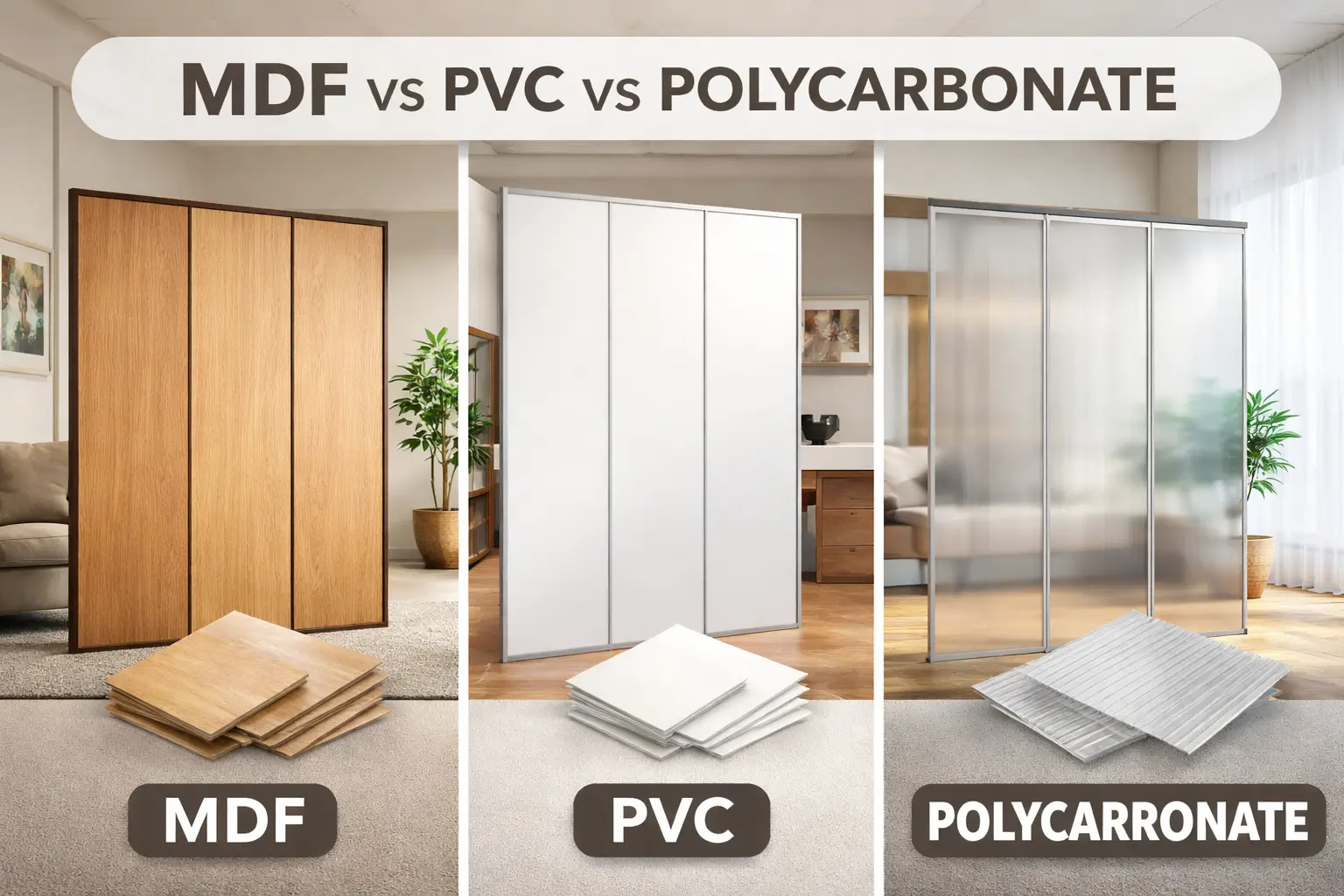
Removable room dividers have become one of the most practical and versatile solutions for homeowners who want to reorganize their living spaces without permanent renovations. Whether you want to create a home office, separate a bedroom from a living room, or improve privacy in a shared space, removable dividers offer flexibility, affordability, and convenience. However, the effectiveness and longevity of your divider depend heavily on the material you choose.
Three of the most commonly used materials are MDF (Medium Density Fiberboard), PVC (Polyvinyl Chloride), and polycarbonate. Each material has unique strengths, weaknesses, and ideal use cases. Choosing the wrong one can lead to issues such as poor durability, excessive weight, moisture damage, or unsatisfactory appearance.
This detailed guide will walk you step by step through everything you need to know about MDF, PVC, and polycarbonate for removable room dividers. By the end, you will understand which material fits your specific needs, environment, budget, and design preferences.
What Are Removable Room Dividers and How They Work
Removable room dividers are non-permanent panels or structures designed to separate spaces without modifying the building’s structure. Unlike traditional walls, they do not require demolition, permits, or structural alterations.
Common situations where removable dividers are useful:
- Creating a home office in a living room
- Separating sleeping and living areas in studio apartments
- Adding privacy in shared bedrooms
- Dividing large rooms into functional zones
- Improving organization and visual structure
Main advantages of removable room dividers:
- No permanent construction required
- Easy installation and removal
- Affordable compared to building walls
- Flexible and adjustable
- Ideal for renters and homeowners
The material you choose directly affects durability, appearance, ease of installation, and long-term performance.
Understanding MDF: Structure, Features, and Performance
MDF, or Medium Density Fiberboard, is an engineered wood product made by compressing wood fibers with resin under high pressure and temperature. The result is a dense, smooth, and uniform board that resembles natural wood.
Key characteristics of MDF:
- Smooth and consistent surface
- Easy to paint or finish
- Dense and solid structure
- Wood-like appearance
- Affordable alternative to solid wood
Because of its appearance and versatility, MDF is widely used in furniture, cabinets, and decorative panels.
Advantages of MDF for Removable Room Dividers
1. Excellent aesthetic appeal
MDF offers one of the best visual finishes among affordable materials. It can be customized to match almost any interior style.
You can finish MDF with:
- Paint for modern designs
- Wood veneer for natural appearance
- Laminate for durability
- Decorative panels for custom designs
This makes MDF ideal if your divider is part of your interior decoration.
2. Easy to customize and modify
MDF is very easy to work with, especially for DIY projects. You can:
- Cut it with basic tools
- Drill holes easily
- Sand edges smoothly
- Add decorative patterns
This flexibility allows you to create unique and personalized designs.
3. Good structural stability indoors
When used in dry indoor environments, MDF remains stable and reliable. It does not warp easily under normal indoor conditions.
Disadvantages of MDF You Must Consider
1. Poor moisture resistance
This is MDF’s biggest weakness. Exposure to moisture can cause:
- Swelling
- Warping
- Structural weakening
Because of this, MDF is not ideal for humid environments.
2. Heavy weight makes installation harder
Compared to PVC and polycarbonate, MDF is significantly heavier. This creates challenges such as:
- More difficult handling
- Need for stronger support
- Harder installation for one person
3. Moderate durability against impacts
MDF can chip or dent if hit with force. It is less impact-resistant than plastic materials.
Understanding PVC: Lightweight and Moisture-Resistant Solution
PVC (Polyvinyl Chloride) is a plastic material widely used in construction and interior design due to its durability and resistance to environmental factors.
Key characteristics of PVC:
- Lightweight structure
- Waterproof surface
- Resistant to humidity
- Easy to clean
- Affordable price
PVC is especially popular for practical and functional dividers.
Advantages of PVC for Removable Room Dividers
1. Excellent resistance to moisture and humidity
PVC is completely waterproof, making it ideal for areas where moisture is present.
Perfect locations for PVC dividers include:
- Kitchens
- Laundry rooms
- Basements
- Humid climates
2. Very easy installation process
PVC is lightweight, making it easier to install than MDF.
Benefits include:
- Easy handling
- Faster installation
- Less structural support needed
- Ideal for DIY beginners
3. Low maintenance requirements
PVC requires minimal maintenance. You only need:
- Occasional cleaning with a cloth
- No sealing or painting required
4. Good durability for everyday use
PVC resists:
- Moisture
- Minor impacts
- Wear and tear
Disadvantages of PVC You Should Know
1. Less premium appearance
PVC does not look as luxurious as MDF or as modern as polycarbonate. It may appear more basic.
2. Lower rigidity compared to MDF
PVC panels may flex slightly, especially if thin.
This can affect:
- Stability
- Perceived quality
Understanding Polycarbonate: Modern and High-Performance Material
Polycarbonate is a high-performance plastic known for its strength, light weight, and transparency.
It is often used in:
- Modern architecture
- Protective panels
- Transparent partitions
Advantages of Polycarbonate for Room Dividers
1. Exceptional durability and impact resistance
Polycarbonate is extremely strong and resistant to damage.
It can withstand:
- Impacts
- Pressure
- Daily wear
This makes it one of the most durable options.
2. Allows natural light to pass through
This is one of polycarbonate’s biggest advantages. It maintains brightness while dividing spaces.
Benefits include:
- Brighter rooms
- Better visual openness
- Modern appearance
3. Lightweight and easy to install
Despite its strength, polycarbonate is lightweight.
This makes installation easier and faster.
4. Modern and premium visual appeal
Polycarbonate creates a contemporary, professional look.
Disadvantages of Polycarbonate
1. Higher cost compared to MDF and PVC
Polycarbonate is more expensive, which may affect budget-sensitive projects.
2. Surface can scratch if not protected
Proper handling and cleaning help prevent scratches.
Direct Comparison: MDF vs PVC vs Polycarbonate
| Feature | MDF | PVC | Polycarbonate |
|---|---|---|---|
| Weight | Heavy | Very light | Light |
| Moisture resistance | Poor | Excellent | Excellent |
| Durability | Moderate | Good | Excellent |
| Appearance | Premium wood look | Basic | Modern and sleek |
| Cost | Low | Low | Medium to high |
| Ease of installation | Moderate | Easy | Easy |
| Maintenance | Moderate | Easy | Easy |
| Light transmission | None | None | Excellent |
Step-by-Step Guide: How to Choose the Best Material
Follow these steps to make the right decision.
Step 1: Evaluate your environment
Ask yourself:
- Is the area humid?
- Is moisture present?
- Is it a dry indoor environment?
If humidity is present, choose PVC or polycarbonate.
If dry, MDF is also suitable.
Step 2: Consider your design goals
If your priority is:
- Traditional look → choose MDF
- Practical function → choose PVC
- Modern look and brightness → choose polycarbonate
Step 3: Consider installation difficulty
If you want easy installation, choose:
- PVC or polycarbonate
Avoid MDF if you want the easiest installation.
Step 4: Evaluate durability needs
If durability is critical, choose:
- Polycarbonate (best option)
- PVC (second best)
Step 5: Consider your budget
Budget-friendly options:
- PVC (best budget option)
- MDF (good balance)
Premium option:
- Polycarbonate
Installation Tips for Each Material
Installing MDF divider
Steps:
- Measure your space
- Cut MDF panels to size
- Attach support frame
- Secure MDF panels
- Apply finish if desired
Installing PVC divider
Steps:
- Measure the space
- Cut PVC panels
- Attach lightweight frame
- Secure panels
- Ensure stability
Installing polycarbonate divider
Steps:
- Measure accurately
- Use proper cutting tools
- Install support structure
- Secure panels carefully
Maintenance Guide for Long-Term Durability
MDF maintenance:
- Avoid moisture exposure
- Clean with dry cloth
- Apply protective finish
PVC maintenance:
- Clean with damp cloth
- Avoid excessive force
Polycarbonate maintenance:
- Clean gently
- Avoid abrasive cleaners
Final Recommendation: Which Material Is Best
Choose MDF if:
- You want best decorative appearance
- You are working in dry environments
- You want customization flexibility
Choose PVC if:
- You want low cost
- You need moisture resistance
- You want easy installation
Choose polycarbonate if:
- You want maximum durability
- You want modern appearance
- You want light transmission
Conclusion
Choosing between MDF, PVC, and polycarbonate for removable room dividers depends on your priorities, environment, and design goals. MDF offers excellent visual quality and customization but requires dry conditions. PVC provides affordability, moisture resistance, and ease of installation, making it ideal for practical applications. Polycarbonate offers superior durability, modern aesthetics, and light transmission, making it the best option for premium and long-term solutions.
By carefully evaluating your space, budget, and installation needs, you can select the material that provides the best balance between performance, durability, and appearance.
Frequently Asked Questions
What is the best material overall?
Polycarbonate offers the best durability and modern appearance.
What is the cheapest option?
PVC is usually the most affordable.
What material is best for renters?
PVC and polycarbonate are best due to easy installation.
Which material lasts longest?
Polycarbonate lasts the longest.
Which material looks best?
MDF looks best for traditional designs, while polycarbonate looks best for modern designs.