
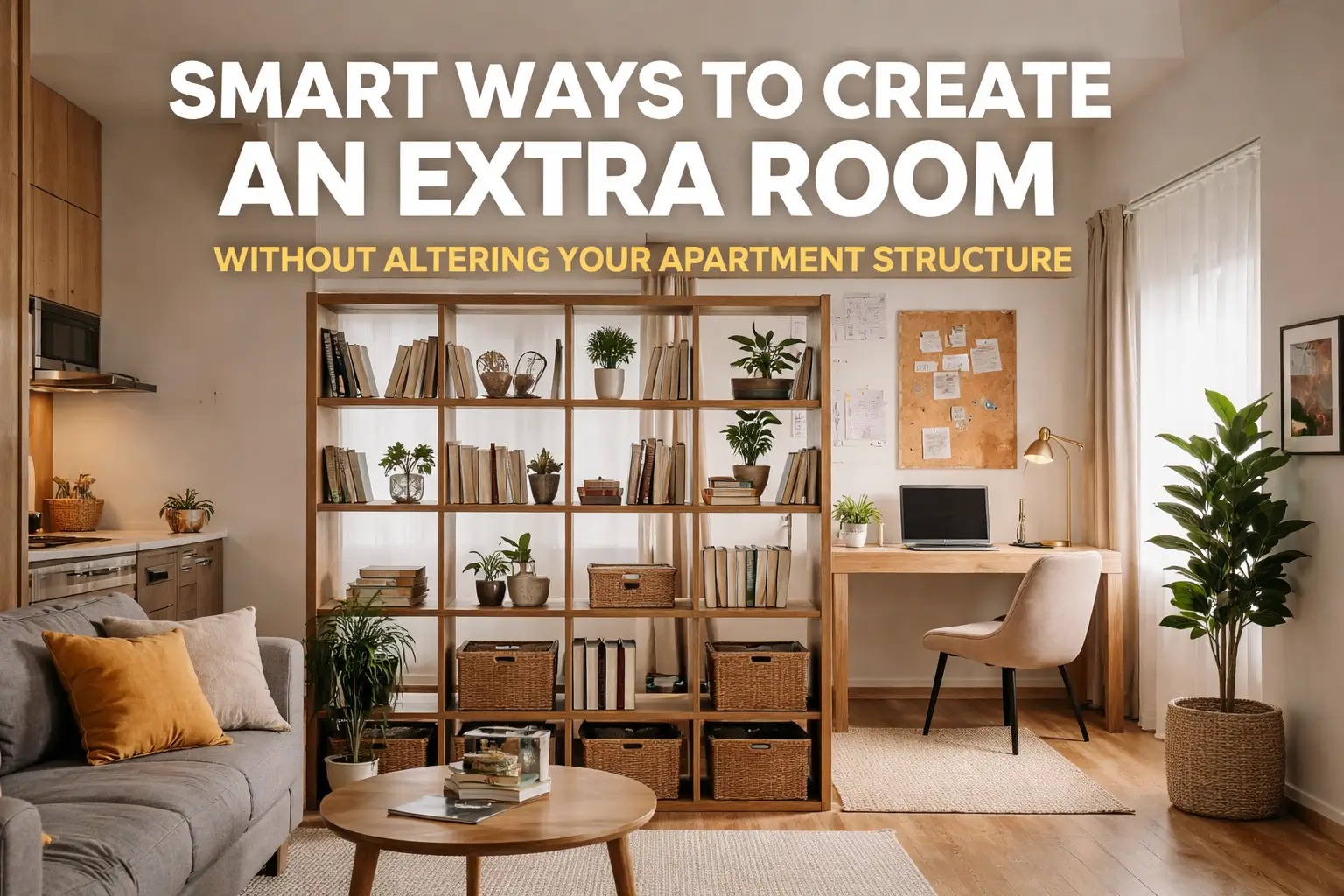
Living in a rental apartment comes with one major limitation: you don’t fully control the structure. You can’t knock down walls, build new ones, or make permanent changes. And yet, life changes fast. Maybe you’ve started working from home. Maybe a partner moved in. Maybe you simply need a quiet place to focus, relax, or host guests.
The core problem isn’t just space — it’s adaptability. Most apartments are designed as fixed layouts, but modern lifestyles require flexible environments.
The good news is this: you can create an extra room without altering your apartment structure. You just need to think differently about space division, functionality, and design psychology.
Let’s break this down step by step.
Step 1: Redefine What a “Room” Actually Means
Before buying anything, shift your mindset.
A room is not defined only by walls. It is defined by:
- Visual separation
- Functional purpose
- Lighting variation
- Sound buffering
- Movement flow
If you can control those five elements, you can create the feeling of a separate room without construction.
Start by asking:
- What is the purpose of this extra room?
- Does it need full privacy or just visual division?
- Is sound insulation important?
- Will this be temporary or long-term?
Clarity at this stage prevents wasted money and clutter later.
Solution 1: Use Freestanding Room Dividers for Instant Structure
Freestanding dividers are one of the smartest ways to create an extra room without altering your apartment structure because they require zero installation.
Why They Work
They create vertical boundaries, which the brain interprets as architectural separation. Even without a solid wall, your mind registers a divided space.
Step-by-Step Implementation
- Measure your ceiling height. Choose dividers at least 70–80% of that height for better separation.
- Choose the right material:
- Open-back bookshelf (adds storage)
- Wooden slatted panel (modern and breathable)
- Folding screen (budget-friendly)
- Metal frame glass-style divider (industrial look)
- Position it strategically.
- Avoid blocking windows.
- Keep at least 30 inches for walking pathways.
- Anchor visually, not structurally.
- Add a rug underneath.
- Place furniture aligned with the divider.
Pro Tip
If you use an open bookshelf, style both sides intentionally. This makes each area feel independent rather than like a cut-off corner.
Solution 2: Install Ceiling-to-Floor Curtain Systems
Curtains are one of the most flexible solutions available to renters.
They create softness, privacy, and flexibility — all without drilling if you use tension rods or pressure-mounted tracks.
Why Curtains Are Powerful
- They absorb some sound.
- They allow quick transformation.
- They create full visual separation when closed.
- They disappear when opened.
Step-by-Step Guide
- Choose the right fabric.
- Blackout for bedrooms.
- Linen or cotton for lighter divisions.
- Install tension rods or pressure systems.
- Measure wall-to-wall width.
- Ensure the rod is rated for the curtain weight.
- Hang from ceiling height if possible.
Curtains that start high create the illusion of taller ceilings. - Layer for depth.
Combine sheer + blackout for versatility.
Ideal Uses
- Creating a temporary bedroom in a studio.
- Separating a home office from a living area.
- Hiding storage zones.
Curtains are especially effective in studio apartments where flexibility is essential.
Solution 3: Use Furniture to Create Architectural Zones
One of the biggest mistakes renters make is pushing all furniture against walls. That approach actually makes a space feel smaller and undefined.
Instead, use furniture as structural tools.
The Concept of Zoning
Zoning means assigning a clear purpose to each area and visually reinforcing it.
Step-by-Step Zoning Strategy
- Start with a large anchor piece.
- A sectional sofa
- A tall bookshelf
- A dining table
- Rotate furniture intentionally.
Instead of facing everything toward the same direction, create orientation shifts. - Add a rug per zone.
Rugs define boundaries without physical barriers. - Use lighting differentiation.
- Floor lamp for living zone
- Desk lamp for office zone
- Pendant light for dining zone
- Add a console table behind sofas.
This visually separates spaces while adding functionality.
Example Layout
Living Room → Sofa facing inward
Behind Sofa → Console Table
Behind Console → Desk Area
Instant office separation without building anything.
Solution 4: Invest in Convertible and Multifunctional Furniture
If square footage is limited, functionality must multiply.
Convertible furniture allows one space to serve multiple roles.
High-Impact Options
- Murphy bed (vertical fold)
- Sofa bed
- Fold-down wall desk
- Expandable dining table
- Storage ottomans
Step-by-Step Planning
- Identify the least-used time block of your space.
- Assign a secondary function during that time.
- Choose furniture that transitions quickly.
- Ensure storage is integrated.
For example:
- Living room by day.
- Guest bedroom by night.
The key principle: maximize usage per square foot.
Solution 5: Temporary Wall Systems for Long-Term Renters
If you need stronger separation — like converting a studio into a one-bedroom layout — temporary wall systems can be a serious solution.
These systems use pressure poles between floor and ceiling and do not require drilling.
Before Installing
- Check your lease agreement.
- Confirm ceiling height compatibility.
- Ensure emergency exits remain accessible.
Installation Process Overview
- Measure the exact width and height.
- Assemble frame panels.
- Secure with pressure locking mechanisms.
- Add optional door components if needed.
These systems offer:
- More sound privacy
- Greater visual realism
- Increased perceived apartment value
They’re ideal for renters planning to stay at least one year.
Solution 6: Maximize Vertical Space for Hidden Room Creation
Floor space is limited. Vertical space is often underused.
Vertical Strategies
- Loft beds with desk underneath.
- Tall open shelving units.
- Hanging plant installations.
- Elevated storage platforms.
Step-by-Step Vertical Upgrade
- Evaluate ceiling height.
- Choose furniture proportional to height.
- Keep upper elements visually light.
- Maintain airflow and natural light.
By elevating one function, you free the ground plane for another — effectively creating layered room functions.
Solution 7: Use Visual Tricks to Reinforce Separation
Even after dividing space physically, visual consistency reinforces the illusion of a room.
Visual Differentiation Techniques
- Use different paint tones with peel-and-stick wallpaper.
- Apply distinct lighting temperatures.
- Change rug textures between zones.
- Add mirrors to redirect depth.
The brain reads contrast as separation. You don’t need walls — you need signals.
Common Mistakes to Avoid
Avoid these errors when creating an extra room:
- Blocking windows completely.
- Choosing dividers that are too short.
- Overcrowding with heavy furniture.
- Ignoring walking paths.
- Forgetting ventilation.
A room must breathe to feel comfortable.
Budget Breakdown for Smart Room Creation
Under $150
- Curtain systems
- Folding screens
- Large area rugs
$150–$600
- Bookshelf dividers
- Modular storage systems
- Convertible desks
$600+
- Murphy beds
- Temporary wall systems
- Custom modular partitions
Start small and scale intentionally.
Final Thoughts
Creating an extra room without altering your apartment structure is not about construction — it’s about strategic design. Renters often feel stuck because they focus on what they cannot change instead of what they can redefine.
By combining vertical elements, zoning strategies, temporary partitions, and multifunctional furniture, you can transform a standard rental layout into a flexible, high-functioning living space.
You don’t need permission to be creative. You only need a plan.
Frequently Asked Questions
1. Can I create a bedroom in a studio apartment legally?
It depends on local housing codes and your lease. Always verify before installing temporary walls.
2. What is the most affordable way to create privacy?
Ceiling-to-floor curtains with tension rods are typically the most budget-friendly solution.
3. Do freestanding dividers reduce natural light?
Open-back shelves and slatted panels maintain light flow while still creating division.
4. How can I reduce sound without construction?
Use heavy curtains, rugs, upholstered furniture, and soft materials to absorb sound.
5. Is it worth investing in modular systems if I might move?
If the system is reusable and you plan to relocate within a few years, it can still be a smart long-term investment.